Stop Asking AI to Teach You. Ask It to Test You Instead
ChatGPT is very good at explaining things. That is useful, but it also makes learning with it a little dangerous.
You ask it to explain database indexes, AWS networking, or why retries can create duplicates. The answer is clear, the examples make sense, and for a moment the topic feels easy.
Then you close the chat and try to explain the same idea without looking. It is suddenly much harder.
A clear explanation can make something feel familiar before you can actually use it. So I prefer a small change to the usual flow: try first, then ask for help.
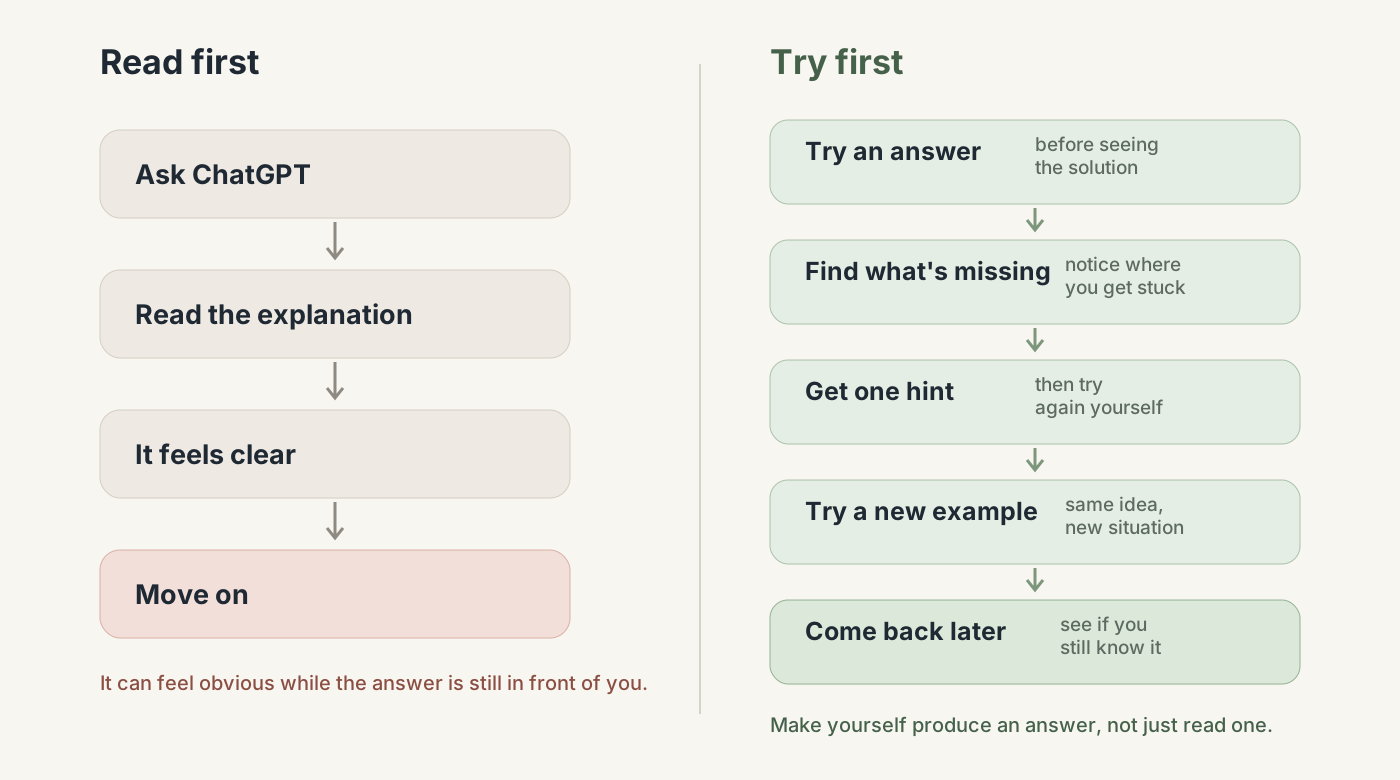
Try before you see the answer
Suppose you are learning why retries can cause duplicate payments.
You could ask:
Explain why retries can create duplicate payments.Or you could ask:
Give me a realistic situation that tests whether I understand safe retries.
Do not explain the answer first.
ChatGPT might give you this:
A customer presses Pay. The payment succeeds on the server, but the response never reaches the phone. The app retries the request. What could go wrong?
Now you have to answer before seeing the solution. Maybe you notice that the customer could be charged twice. Maybe you know there should be a way to recognize the repeated request but cannot explain how. Maybe you miss the problem completely.
All of those answers are useful because they show what you can do on your own. That is more useful than asking whether an explanation made sense while you were reading it.
When you get stuck, ask for a hint
If your answer is wrong, you do not need the full solution immediately. A small hint often gives you another chance to work it out.
You:
The retry should be fine because it sends the same request again.

ChatGPT:
What if the first payment already finished and only the response was lost?

You:
Then the second request could charge the customer again.
The server needs a way to recognize that this is the same payment attempt.
The useful part is not the hint itself. It is the second attempt. You were missing one piece, the hint pointed at it, and you still had to connect it to the answer.
If one hint is not enough, ask for another. If you are completely stuck, read the explanation. There is no value in turning every topic into a struggle. The goal is just to give yourself a chance to think before ChatGPT does all the thinking for you.
Change the example
There is another trap that is easy to miss. You answer incorrectly, read the correction, then answer the same question again and get it right. That feels good, but you just saw the answer.
Change the situation instead.
If the first example was a payment retry, the next one could be a welcome email sent twice, a support ticket created twice after a slow response, or a file upload submitted again after the connection drops.
The details changed. The question underneath did not: what happens when the same action is attempted more than once?
If you can spot that pattern in a new situation, you have better evidence that you understand it.
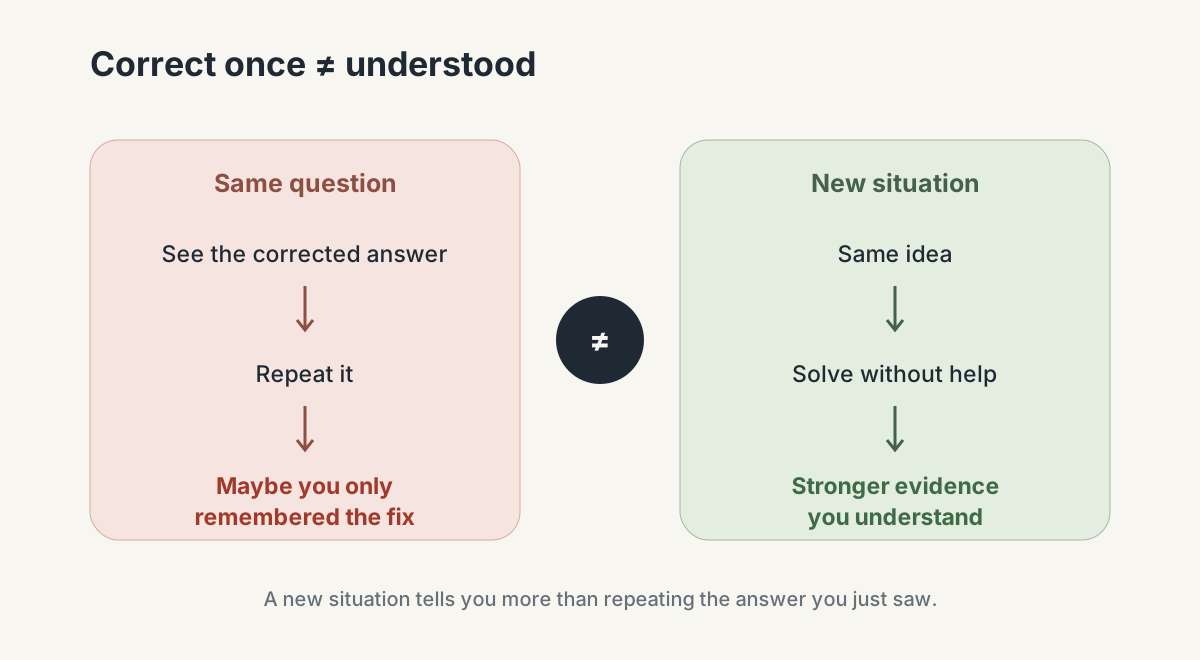
This is one line I now think belongs in most learning prompts:
After I fix a mistake, give me a different example that uses the same idea.Some things need practice, not more explanation
This matters even more for skills.
Take speaking English. You can study the past tense, understand the rule, and answer grammar exercises correctly. That does not mean the right sentence will appear naturally when someone asks what you did last weekend.
There is a big difference between this:
Use the past tense.

I went to the gym yesterday.
and this, later in a normal conversation:
What did you do last weekend?

I went to my hometown and met some friends.
In the second case, nobody reminded you which rule to use. You had to produce it when the situation called for it.
The same applies to writing, debugging, coding, presenting, or using a tool. At some point, stop asking ChatGPT to explain the skill and use it to create a chance to perform the skill.
For speaking, have a conversation. For writing, write first and ask for feedback after. For debugging, inspect the broken example before asking for the diagnosis. For coding, implement a small piece before asking for finished code.
Try it again later
A correct answer right after a hint is still close to the original explanation. The clues are fresh.
Come back later. Use different wording. Pick another example. Do not reread the old answer first.
You do not need a perfect review schedule. The simple idea is enough: let some of the context disappear, then see whether you can still work through the problem.
A smooth hour-long conversation with ChatGPT can feel productive. What matters more is whether you can still do the thing after the conversation is gone.
After enough sessions, this creates a new problem. You start wondering what you are still weak at, what you only solved after a hint, what you can now do without help, and what should come back later.
Chat history contains pieces of that information, but it is hard to treat it as a learning record. I ended up using GitHub Issues to keep the small amount of progress that needs to survive between chats. Here is how that setup works.
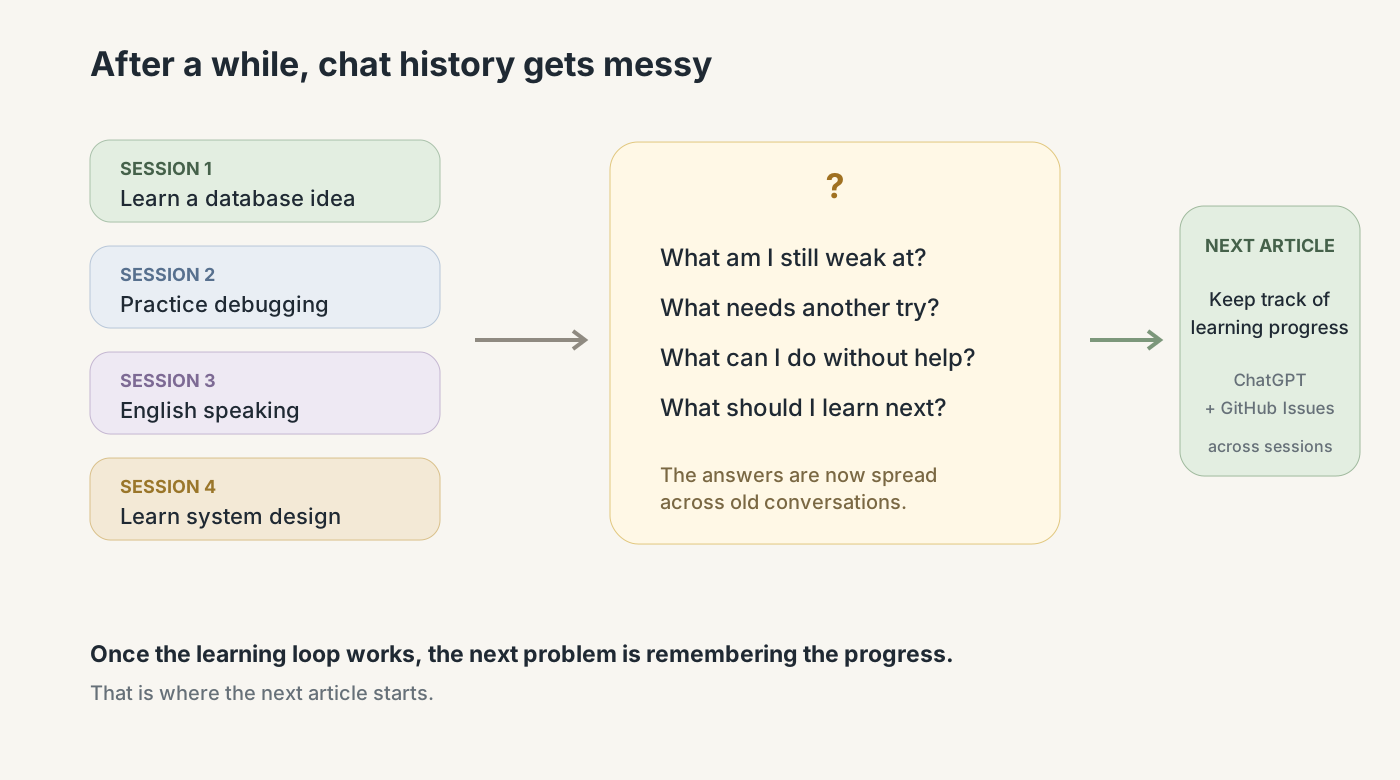
For now, the learning loop can stay small:
try first
→ notice what is missing
→ get a hint if needed
→ try again
→ change the example
→ come back later
A prompt you can copy
Test my understanding of <topic> with a realistic situation.
Do not explain the answer first.

Let me answer in my own words.
If I am partly wrong, give me one useful hint before giving the full answer.

After I fix the mistake, give me a different situation that uses the same idea.
Bring important ideas back later so I can try them again without looking at the old answer.
ChatGPT can still teach you. Just do not make explanation the first step every time. Try something first, give it something real to correct, and the explanation becomes much more useful.